
Introduction: A New Age of Entertainment
Gaming has evolved from a simple pastime into one of the most influential cultural and technological phenomena of the modern age. What started as a few blinking pixels on a screen has grown into a multibillion-dollar global industry that rivals — and often surpasses — film, music, and sports in terms of both scope and impact. The transformation of gaming is not just about better graphics or faster consoles; it is about how games have become a powerful medium of expression, storytelling, social interaction, and even education. The journey of gaming reflects the evolution of technology itself, mirroring human creativity and curiosity in its purest digital form.
The Origins: When Pixels Ruled the Screen
The story of gaming began humbly, with the earliest electronic games designed as experiments rather than entertainment products. Games like Pong and Space Invaders defined an era when the concept of controlling images on a screen felt revolutionary. These primitive visuals and simple mechanics might appear laughable today, but in their time, they were a window into a new kind of experience. People were suddenly interacting with machines in ways that were playful, challenging, and deeply satisfying.
Arcades soon became social hubs. They were not just rooms full of machines; they were arenas where skill, reflexes, and determination were tested. The flashing lights and electronic sounds created an atmosphere that could transport players to other worlds. The simplicity of early games forced developers to rely on pure gameplay design — every movement, every pixel mattered. It was an age of imagination, where limitations fueled creativity.
The Rise of Consoles: Bringing the Arcade Home
As technology advanced, gaming began to enter the household. The birth of home consoles such as the Atari and later the Nintendo Entertainment System transformed gaming from a public pastime to a personal experience. Suddenly, entire families gathered around the television to play together. Mario jumped, Link explored, and players felt the thrill of controlling characters on their own screens for the first time.
This was a period when gaming began to take shape as both a hobby and a form of storytelling. Developers experimented with worlds, characters, and emotions. Franchises like The Legend of Zelda and Final Fantasy introduced narratives that captivated players far beyond simple score chasing. For many, these games were their first encounter with epic adventures, moral choices, and emotional endings.
The controller became an extension of the player’s imagination. It wasn’t just about pressing buttons; it was about stepping into someone else’s shoes, living their struggles, and shaping their destiny. Games stopped being mere entertainment and became interactive stories — experiences that left lasting memories.
The 3D Revolution: A Leap into Immersion
The 1990s marked a turning point in gaming history — the transition from 2D sprites to 3D environments. This technological leap redefined what games could be. Titles like Super Mario 64, Tomb Raider, and Metal Gear Solid demonstrated that virtual worlds could be vast, lifelike, and fully explorable. Players were no longer confined to flat screens but could move through spaces that felt real, dynamic, and full of possibility.
3D gaming also introduced a new level of artistry. Developers could now craft environments with depth and atmosphere. The foggy streets of Silent Hill, the golden landscapes of Hyrule, or the neon-lit cities of futuristic shooters — each environment told a story of its own. The visual realism invited players to lose themselves in virtual landscapes, creating an unprecedented sense of presence.
Moreover, this period also saw the rise of powerful storytelling. Developers started incorporating cinematic cutscenes, voice acting, and emotional depth into their narratives. Games became not just fun, but meaningful. They reflected human fears, hopes, and ambitions in ways that other media often couldn’t.
The Online Revolution: Connecting the World Through Play
As the internet became widespread, gaming underwent another transformation — it became social. Online multiplayer games created digital communities that transcended geographical boundaries. Players from different parts of the world could now collaborate, compete, and communicate in real-time. It was no longer just about defeating computer-controlled enemies but about connecting with real people.
Massively multiplayer online games like World of Warcraft and Runescape gave birth to entire virtual societies. Players formed friendships, rivalries, and even economies within these digital realms. The concept of teamwork and community grew stronger. People began to spend countless hours exploring shared worlds, participating in raids, and building reputations that often extended beyond the screen.
Online gaming also introduced a new kind of identity. Players could be whoever they wanted — a hero, a trader, a strategist, or a wanderer. Avatars became expressions of self, and the digital world became a second home for many. For some, it was a place of belonging when the real world felt distant.
The Rise of Esports: From Hobby to Profession
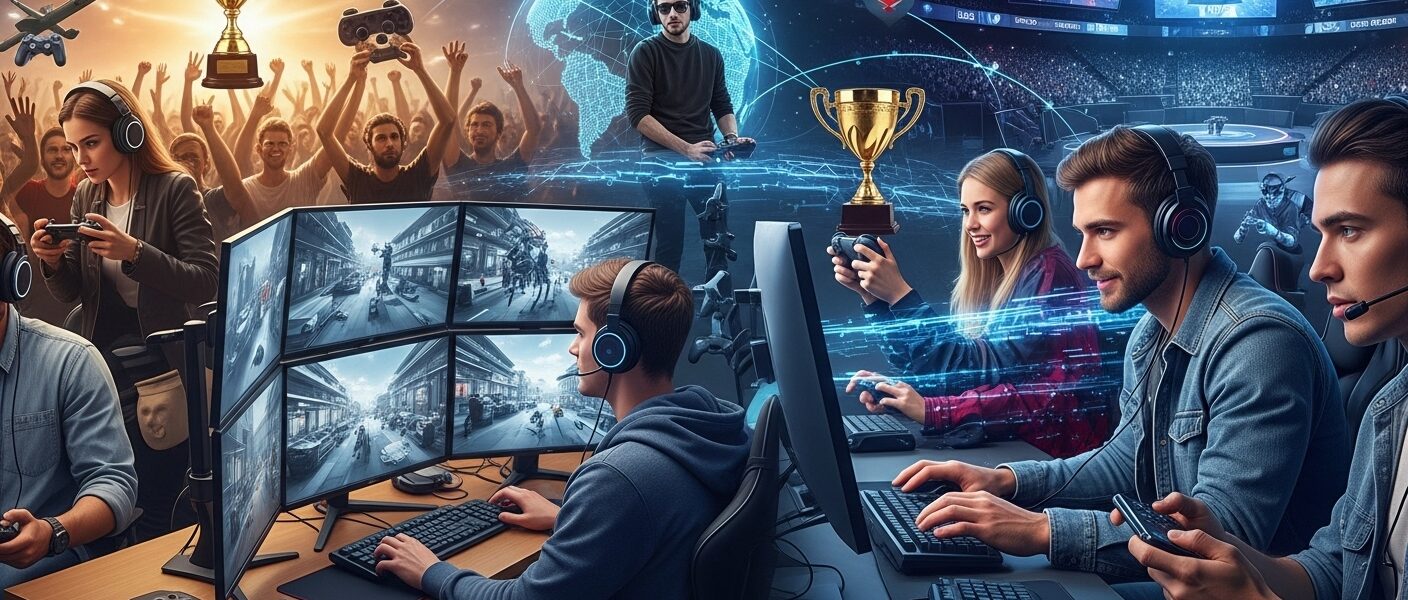
Few could have predicted that playing games would one day become a career. Yet, the rise of esports turned that dream into reality. Competitive gaming evolved into a legitimate professional industry, complete with tournaments, sponsorships, and global fan bases. What began as small competitions in local gaming cafes transformed into stadium-filling events watched by millions online.
Esports athletes train with the same dedication as traditional sports players. Strategy, reflexes, teamwork, and mental endurance all play vital roles. Games like League of Legends, Dota 2, and Counter-Strike: Global Offensive became arenas for digital athletes to showcase their skill. The adrenaline of watching a perfectly executed play or a dramatic comeback can be as exhilarating as any football match or boxing bout.
The rise of streaming platforms further accelerated this trend. Viewers could now watch their favorite players live, learning strategies or simply enjoying their personalities. Gaming content creators became celebrities in their own right, bridging the gap between player and audience. The idea of community in gaming evolved once again — from small circles of friends to global fandoms united by passion.
The Indie Game Renaissance: Creativity Unleashed
While the mainstream gaming industry grew massive, another movement was quietly reshaping the landscape — the rise of indie games. Independent developers, often small teams or even solo creators, began crafting games that focused on innovation, emotion, and storytelling rather than sheer spectacle. Without the constraints of large studios, indie developers could take risks and explore unconventional ideas.
Games like Journey, Hollow Knight, Celeste, and Undertale demonstrated that emotional depth, unique art styles, and thoughtful design could rival — and sometimes surpass — blockbuster titles. These games often carried personal messages, tackling themes like depression, perseverance, love, and identity in intimate ways. They reminded players that gaming wasn’t just about competition or escapism, but also about reflection and connection.
The indie renaissance proved that creativity thrives when boundaries are removed. It also democratized game development, with tools becoming more accessible to aspiring creators. Anyone with a vision and dedication could craft their own world and share it with millions. Gaming became not just something to consume, but something to create.
The Modern Era: A Fusion of Technology and Art
Today, gaming stands at the intersection of cutting-edge technology and artistic innovation. Graphics have reached levels of realism once thought impossible, powered by advanced engines and real-time rendering. Virtual reality and augmented reality have begun to blur the lines between the physical and digital worlds, offering immersive experiences that engage the senses in entirely new ways.
Artificial intelligence now plays a crucial role in creating lifelike characters and adaptive gameplay. Worlds no longer feel static; they respond, evolve, and learn from player behavior. Games are becoming living systems — dynamic, unpredictable, and endlessly fascinating.
At the same time, storytelling has matured. Games like The Last of Us, Red Dead Redemption, and God of War explore complex human emotions with cinematic depth. They challenge players to make moral decisions, to question their beliefs, and to empathize with perspectives beyond their own. In doing so, gaming has solidified its place as one of the most powerful storytelling mediums of the modern era.
The Cultural Impact: Beyond the Screen
Gaming is no longer confined to entertainment. Its influence extends into art, fashion, education, and even politics. Characters from games appear on clothing, in movies, and across social media. Gaming conventions attract thousands of fans celebrating creativity and community. The culture around gaming has become a shared language for a global generation.
In education, games are now used to teach problem-solving, collaboration, and critical thinking. Gamification — the application of game principles to non-gaming contexts — has reshaped how we learn and engage. From classrooms to corporate training, gaming mechanics inspire motivation and participation in new ways.
Moreover, gaming has created powerful social connections. Online communities often become support systems where people find friendship, empathy, and understanding. For many, games provide an escape from isolation and a space for expression. They offer worlds where one can be brave, free, and creative without judgment.
The Challenges: Addiction, Toxicity, and Balance
Yet, like all cultural phenomena, gaming faces challenges. The immersive nature of games can lead to unhealthy habits if not balanced with real-world responsibilities. The line between engagement and addiction can blur, particularly in games designed to reward constant play. Developers and players alike must navigate the ethical considerations of this digital age.
Another issue is the persistence of toxicity within online spaces. Anonymity can sometimes bring out the worst in people, leading to harassment and exclusion. However, the gaming community is also increasingly aware of these problems, and many developers and players are working to create more inclusive, respectful environments.
The key lies in balance. Games can enrich lives, but they must coexist with real experiences. The best gamers understand that success in virtual worlds is most rewarding when it enhances, not replaces, their real-world growth and connections.
The Future of Gaming: Boundless Horizons
Looking ahead, the future of gaming feels limitless. As technology continues to evolve, so too will the possibilities for storytelling, interaction, and creativity. Virtual reality, artificial intelligence, and cloud gaming will make experiences more accessible and personalized than ever before.
The dream of the metaverse — a shared, persistent digital universe — may soon become reality. In this vision, games won’t just be separate titles but interconnected worlds where players can live, work, and create. Imagine a space where creativity is infinite, where imagination has no end.
Beyond technology, the spirit of gaming will continue to evolve as a form of human expression. Every generation of gamers brings new perspectives, new ideas, and new stories to tell. Whether through blockbuster adventures or intimate indie projects, gaming will remain a mirror reflecting who we are and what we aspire to be.
Conclusion: Gaming as the Art of the Digital Age
From its humble beginnings in arcades to the immersive virtual worlds of today, gaming has come a long way. It has transcended its roots to become an art form, a community, and a powerful force of cultural change. Games inspire creativity, teach resilience, and connect people across boundaries that once seemed insurmountable.
To play is to explore, to learn, to dream. Every click, every quest, every story played is a reminder of what makes us human — our desire to connect, to imagine, and to create meaning from the worlds we build. The evolution of gaming is far from over; in many ways, it has only just begun.
As long as curiosity and imagination drive us, gaming will continue to grow — not just as a form of entertainment, but as one of the most profound expressions of human creativity ever conceived.